Ronan O'Kelly and Simon Hagens Co-Chairs Policy Environments Workstream
Context
Digital health advancement has taken on greater urgency in recent years, driven by lessons and after-effects from the pandemic, increased pressure on health systems, increased cybersecurity risks, and opportunities presented by new technology. As such, countries are increasingly concerned with having the right data infrastructure in place for supporting the delivery of care, producing health statistics, and measuring health care quality and outcomes. Specifically, this includes data linkage between settings and levels of care, and mechanisms to generate and use timely, actionable data to support better clinical care, research, and health system planning. Interest in strengthening health information systems has grown since the COVID-19 pandemic. This interest has shone light on the importance of having reliable, up-to-date information readily available to inform health system decision-making. The pandemic also showed that more digitized health systems were better equipped to deliver uninterrupted care, all while monitoring and responding to the crisis. As health systems struggle to recover from the surge in care needs and workforce shortages, gaps in access to care and clinician burnout persist and demand solutions. Advancements in information technology offer great promise, if applied effectively. Where there are common challenges internationally, so too is there the potential for common solutions, realized through further cooperation and sharing of best practices worldwide.
Global Digital Health Partnership
The Global Digital Health Partnership (GDHP) brings together national governments and international organizations collaborating to advance digital health on a global level. The GDHP has five designated ‘Workstreams’ focused on the advancement of different digital health initiatives. GDHP Workstreams pursue tangible digital health initiatives to align activities and accelerate progress around topics like evaluation, clinical and human engagement, and interoperability. Top of mind for all Workstreams is the challenge presented by lack of access to relevant information. Indeed, digital health development and innovation relies upon the access of knowledge and information sharing, especially for rapid dissemination. The rise and application of advanced information technologies means there is a great opportunity for knowledge building, community interaction, innovation, and collaboration.
Origanization for Economic Co-operation and Development
The Organization for Economic Co-operation and Development (OECD) is an international entity where national governments collaborate with various health system stakeholders. Together, all stakeholders exchange evidence and experiences, address shared economic, social, and environmental challenges, identify best practices, and create evidence-based international standards. Drawing on over 60 years of experience and insights, the OECD works to better prepare the world of tomorrow. The OECD is a partner of the GDHP, and an active contributor in its various Workstreams.Impetus for the Policy Reference
In October 2022, at the 10th GDHP summit in Rotterdam, the first in-person summit following the pandemic, common international themes quickly emerged. Collaboration with GDHP members during the pandemic years had been focused on the response, vaccine deployment and certificates, and virtualization of care. During transition into the recovery phase, there was an increasing acknowledgement of global challenges related to health data, interoperability, and policy. Addressing these challenges became a heightened priority for the Policy Environments Workstream, prompting a call to action to share best practices in policy and seek opportunities for alignment and collaboration. To meet this need, the Policy Environments Workstream developed the initial ‘Data Collection Tool’, which was further refined through a pilot project. The pilot project involved several early participant countries, and now currently sits at 13 in total. In December 2022, a broader call for country contributions was issued to the Workstream, including a presentation of the work conducted by Michael Peolsson, whose efforts played an important role in laying the foundation for data collection. At the subsequent 2023 Summit in Washington, D.C., the initial data set was shared with the Policy Environments Workstream. Participants found the information collected through the pilot project to be highly valuable and discussed expanding the work. Following this meeting, a broader call for participation was made to all GDHP members.
Building upon the OECD Policy Checklist: The OECD-GDHP Policy Repository Tool
The ‘OECD Policy Checklist’ was first published in the OECD Health at a Glance 2023 Report, in the feature chapter on Digital Health. The Checklist proposes a foundation for policies that support an integrated digital health ecosystem, and overall, is an important reference point to consider the contributions of GDHP members against future benchmarks. It was first introduced as a tool to bring together a high-level checklist of policies for digital health across analytics (including AI), data, technology, and the human factors that hold them together. This enables countries to map their digital health policies to determine their policy readiness, as well as identify existing and future needs. Additionally, this Checklist allows GDHP members to identify leading examples in areas such as privacy and interoperability and provides a centralized location for accessing this information. The OECD is currently working with the GDHP towards publishing an elaborated version of the Policy Checklist in late 2024.- Enabling users to view a specific area of interest through a filter functionality (e.g. interoperability, digital ID) and identify leading policy practices.
- Enabling individual countries to map themselves against the Checklist, which will allow them to see existing policies in place and existing gaps within their own country.
- The filter functionality will also further support the user to view gaps, and ultimately compare against the progress of peer countries.
- The Tool provides a useful resource for countries, each at different stages of their own digital maturity journey, to easily identify and learn from the progress of other countries. The learnings can help shape their own country’s policy development.
- In addition, the Tool provides opportunities for countries to focus on areas of common interest and facilitates the building of partnerships and the sharing of knowledge between GDHP members.
Initial insights from analysis performed to date
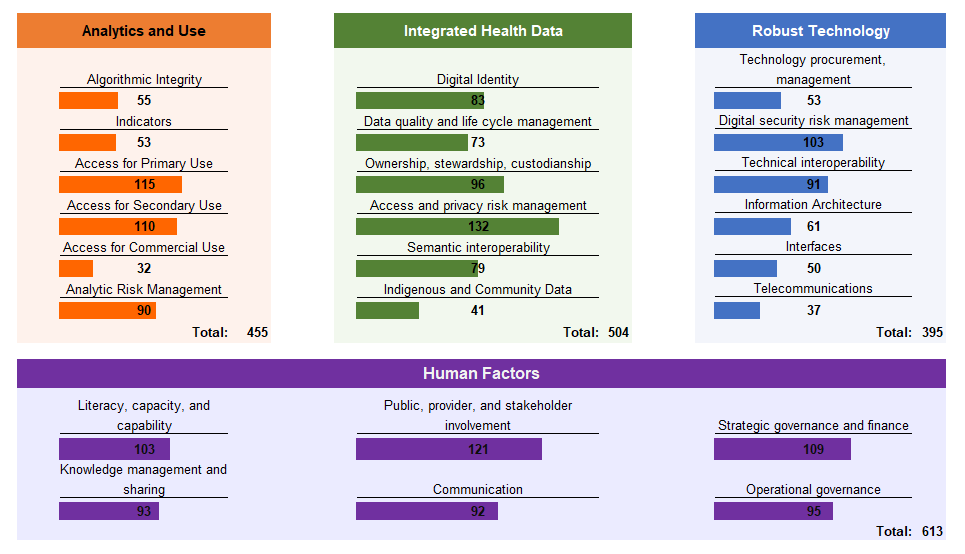
Through a compilation of policy documents from OECD and GDHP members, further themes emerged for consideration. Though there is much variability across member submissions, these themes are important in shaping further dialogue about the Policy Repository Tool.- Some topics, such as privacy rules and clinical engagement, are commonly addressed, while other topics, such as AI, are not as prevalent. Differences in health systems can account for some variation in themes. Through all the submissions, it is important to note that no member has comprehensively addressed the policy foundations for digital health. From a learning perspective, everyone stands to gain from this awareness and the Policy Repository Tool can help by further facilitating conversations around these topics.
- While there are many opportunities to exchange leading policy practices, certain focus areas will benefit from global alignment. For example, Interoperability within the realm of legal, organizational, technical, and semantic aspects. The global nature of patients (e.g., cross-border patient flows and the necessity of receiving care outside of their home jurisdiction), corporations, and disease, requires an international need to communicate and share health data when it is most needed. International alignment on interoperability standards can allow the patient’s information to ‘follow them’ in case of an emergency, and/or for out of country care.
- International interoperability will also benefit other stakeholders in the larger ecosystem. Electronic health record providers can streamline their efforts and resources required to build interfaces and develop new solutions with a standardized, global market in mind.
- The seamless flow of information will enable public health emergencies to be more effectively monitored across borders and mitigate the impact of future pandemics. To realize these benefits, international agreements and aligned policies must be in place across borders, addressing the legal, regulatory, security, and privacy concerns related to sharing health data.
Impression: policy heatmap